
Listed in Arkansas Register of Historic Places on 12/03/25
Summary
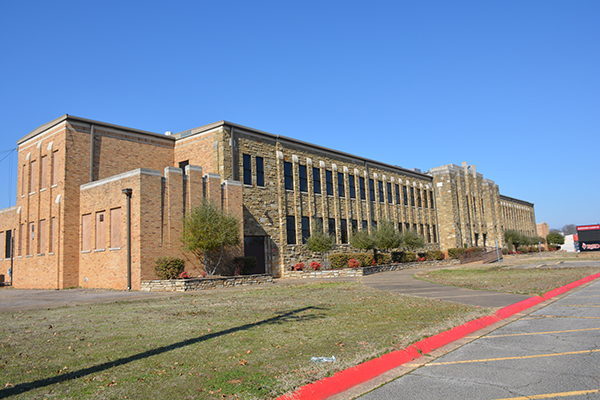
The Russellville Junior and Senior High School was constructed in 1930 in order to provide a more consolidated space for Russellville’s students in the wake of the 1920s school consolidation movement. The original building was designed by John Parks Almand and finished in 1930, but unfortunately burned down nine years later. Due to the pressing need for a new building, the Russellville school district applied to the Works Progress Administration for help securing funding for a new building. Their application was approved and in 1940 construction began on the current building. It was completed in 1943 and functioned as a junior and senior high school until 2002, when it became a secondary education facility for adults and at-risk high school students. The building itself showcases many of the hallmarks of the WPA Rustic style, including the giraffe stones on the façade, the method of construction in salvaging bricks to keep material costs down while employing as many men as possible, and the Art Deco details on the front façade. For its associations with New Deal-era agency funding in Russellville, the School is being nominated to the Arkansas Register under Criterion A: Social History with local significance. It is also being nominated under Criterion C: Architecture with local significance for its intact WPA Rustic style architecture.
Narrative Description
History of the Area
The earliest European settlement in Pope County consisted of hunters and trappers that mainly settled along the Arkansas River and in some of the interior valleys of the county. The site of Russellville is in the former Cherokee Reservation, and the area was home to many Cherokees prior to the arrival of European settlers. However, by the late 1820s, there were enough European settlers in the area to warrant the creation of Pope County on November 2, 1829. In 1830, the county seat was established in Norristown, where it remained until c.1840 when it was moved to Dover. Russellville, the current county seat, was selected and approved in 1886-1887.[1]
The first home in Russellville was built in 1834 and bought the next year by Dr. Thomas Russell, an English doctor who moved to Pope County with his family and practiced medicine in town until his death in 1866.[2] In 1847, when the settlement became an incorporated village, the citizens resolved that the town, which consisted of a general store and five houses, should be given a name. After a vote on June 7, 1870, the “Town of Russellville” was incorporated and named after Dr. Russell.[3]
Although its citizens’ request to be on the stage route was never realized and a post office was not established until the 1880s, their efforts to get the railroad route through the city were successful and resulted in the arrival of the force that most shaped the future development of the town. In 1873 a railroad connecting Little Rock and Fort Smith was built and Russellville was the largest center between the two points. The Memphis and Little Rock Railroad (later Missouri Pacific Railroad and now Union Pacific Railroad) had become operable in 1870. With the railway running through Russellville the town was connected to points east of Arkansas, and points west as far as Indian Territory (later Oklahoma). The rail lines were laid through the center of Russellville parallel to and two blocks north of Main Street.[4]
History of the Property
The years prior to 1930 had a direct impact on the creation of the first Russellville Junior and Senior High School. In the 1920s, education in the state came to the attention of state representatives as the quality of schooling in most locales was subpar compared to other southern states. A survey by the United States Bureau of Education in 1921/22 found that “The average six-month [school] term was the shortest in the country; 28 percent of school-age children were not enrolled, and 32 percent of those enrolled did not attend regularly. Only 2.5 percent of the total enrollment was in high school, the next to lowest percentage in the United States.”[5] The rural schools fared even more poorly in the survey; “Over one-half of their students were too old for the grades in which they were enrolled, and by the age of fourteen or fifteen most had dropped out.”[6]
Proponents of school reform were especially interested in combining small school districts into larger ones, believing that fewer districts would solve the teacher shortage by needing less teachers, provide better facilities to larger amounts of students, and give students the ability to choose from more varied subjects or high school classes. In Russellville, the school board decided to consolidate three of the junior high schools into one building, and leave Russellville High School as a senior-only education center. The school district needed a more centralized, new school building for the junior high, and they opened bids for construction in 1930.[7]
The original school was designed by John Parks Almand, a prominent Arkansas architect known for his work on Central High School and Couchwood, in the late 1920s. The school district let the contract for the building in early May 1930 and awarded the work to E. V. Bird Construction Company.[8] The building features, including faux buttresses, stone trimmings, and cream colored brick, were largely replicated in the later 1940 building. Construction began in June 1930 and was slated to be completed by September at a cost of approximately $55,000. The school originally served grades 7-9 and had a total of sixteen classrooms.[9]
The Russellville school district had applied and been approved in 1938 for a loan to construct a new junior and senior high school which would have replaced the building, but before any final plans were in place, the school burned in late 1939. The school district had to reevaluate their application to the WPA for building funds while having temporary classes in Sherman Elementary School.[10] The school reapplied for funding to build a new school on the site of the burned one and was approved in 1940.[11]
In Russellville’s case, the school benefited from the hiring of an architectural firm to draw architectural plans for the proposed new building. A. N. McAninch, a prominent Little Rock architect, drew heavily from the earlier 1930 Almand design, and when comparing the 1930 building to the 1940 building, little on the front façade changed besides the cladding material.[12] McAninch was paid $4,200 for his architectural drawings, which did include an expanded auditorium addition that was not present in the 1930s school. Additionally, salvaging the bricks, almost 110 thousand, from the old school reduced the material cost and increased the man hours required for construction, as each brick had to be cleaned and checked for integrity before use. In total, the school took 195,070 man hours to construct.[13]
In the late 1950s and 1960s, Russellville experienced a population boom, resulting in the need for expanded city services as well as improved school facilities. In addition to new sewer lines and a municipal airport, Russellville invested $1.2 million in its school facilities. The money was spent on three new schools, in addition to the Cafeteria addition to Russellville Junior and Senior High School, which at the time was used as additional classroom space.[14] Once the new high school was constructed, Russellville Junior and Senior High School became a junior-only educational facility.[15]
The school was for white students only until 1965, when the school was integrated. Previously, Black high school students were bused to Morrilton, as Russellville did not have a Black high school, and the Russellville school district paid for the students’ tuition. Upon the petition of the Negro Civic Club for either a new Black high school or integration, the Russellville school board stated that there were not enough students for a separate building and decided to integrate the high school the next fall in 1965.[16] The lower eight grades were planned to remain segregated, but full integration occurred due to the closure of the James School, the city’s Black elementary and junior high school.[17]
The school continued to operate as a junior and senior high school until a new high school was built in 1971, and the building then housed only junior high school. The building changed uses academically to a secondary learning center for at-risk high school students and adult education in 2002, when the replacement junior high school was built. The building continues to house adult education classes, administrative offices, and secondary classes to the present day.[18]
Criterion A: the WPA in Russellville
Between 1930 and 1932, almost 38% of Arkansans had lost their jobs and the state was $105 million in debt.[19] Forced to appeal to the federal government for assistance, Arkansas benefited from several programs established by President Roosevelt in his “Second New Deal”.[20] One of the most significant was the establishment of work-relief projects through the Works Progress Administration (WPA). The WPA was envisioned as a way to give work to citizens and thereby remove them from living solely on the dole. Projects financed through the WPA had to benefit public health and welfare and were managed through state or local agencies rather than directly overseen by the WPA. Many projects had to have a sponsor who provided at least some of the cost of the project.[21] In 1935 at the outset of WPA employment in Arkansas, 30,000 people gained employment, almost 75% percent of them managed under the construction division.[22]
By March 1, 1938, Pope County had received WPA and other federal benefits totaling $1,036,175, and the Junior and Senior High School was not the only project to receive WPA assistance in the Russellville itself.[23] Nearby Arkansas Tech University was also awarded several contracts with the PWA and WPA, including Hughes Hall and Caraway Hall.[24] In fact, Caraway Hall was funded through a PWA loan and also designed in 1934 by McAninch, who would return six years later to work on the Junior and Senior High School.[25] The Russellville Public Library was also constructed with WPA funds and manpower, and numerous roads and bridge projects utilized WPA assets for construction.[26]
The WPA’s requirement of a sponsor to match funds was a difficult prerequisite to meet, especially in the rural areas and other agriculture-dominant regions. The city of Russellville had originally applied to the WPA in 1938 for assistance in building a new school for junior high and planned to fund it through bond issues. However, that plan fell through when the school burned down in 1940. Subsequently, Russellville applied again and was able to meet the sponsorship requirement through a bond issue and builder’s insurance claims from the burned school. The material savings from salvaging bricks from the old school were also counted towards Russellville’s sponsorship cost. The school district contributed $66,325 and the WPA provided $83,397, bringing the project’s total in 1941 to $149,722. Additional funds were requested in 1942 for extended electrical work and finishing costs; the school provided $14,136 and the WPA funded $16,122. The work was fully completed in 1943.[27]
Criterion C: Architecture
Since its workforce was mostly unskilled, the WPA tailored building design to be uncomplicated, modest, and utilize simple construction techniques, especially ones that required large amounts of manpower. The WPA sought to put as many people back to work as possible, which often translated into the use of hand tools and hand labor instead of with power equipment, and affected the patterns of masonry and design of buildings.[28] “WPA Standardized Style”, as it became known, emphasized simple building forms, lack of ornamentation, and borrowed elements from both the Arts and Crafts movement and Art Deco architecture.[29] The WPA Rustic style was promoted through a three volume publication by Albert Good, largely based on designs by Herbert Maier, in the 1920s and 1930s. The style guide promoted the use of native materials, the construction of buildings with low silhouettes and horizontal lines, and adaptation of local construction methods.[30]
Russellville Junior and Senior High School has many character defining features of the WPA Rustic style as well as method of construction. Besides the obvious architectural elements, the WPA often employed a method of construction that emphasized manual labor in order to employ as many people as possible. At the Russellville Junior and Senior High School, the workers salvaged 110,000 bricks from the previous school, which both took many extra hours but also kept material costs in check with the reused materials. In terms of architecture, the School employed the characteristic giraffe stone on the façade of the building. The sandstone veneer was sourced from local quarries which further exemplifies the WPA mission to use local materials whenever possible. The long horizontal plan of the building, the simple ornamentation and construction, and the rectangular plan are also character-defining features of the WPA Rustic style that can be seen in the Russellville Junior and Senior High School.
There are several examples of the WPA Rustic style in Russellville that also exhibit the character-defining features of the style. Wilson Hall (on N. El Paso Street on Arkansas Tech University’s campus) was originally listed on the National Register (9/18/1992) for its associations with the WPA, but the 2024 additional documentation form found that Wilson Hall was financed by the Reconstruction Finance Corporation, not built by the WPA, and is therefore not a comparable property.[31] Hughes Hall (NR listed 1/18/1990), also on ATU’s campus, was built by the WPA in 1940 and is a good example of WPA construction techniques and style.
Statement of Significance
The Russellville Junior and Senior High School was constructed in 1930 in order to provide a more consolidated space for Russellville’s students in the wake of the 1920s school consolidation movement. The original building was designed by John Parks Almand and finished in 1930, but unfortunately burned down nine years later. Due to the pressing need for a new building, the Russellville school district applied to the Works Progress Administration for help securing funding for a new building. Their application was approved and in 1940 construction began on the current building. It was completed in 1943 and functioned as a junior and senior high school until 2002, when it became a secondary education facility for adults and at-risk high school students. The building itself showcases many of the hallmarks of the WPA Rustic style, including the giraffe stones on the façade, the method of construction in salvaging bricks to keep material costs down while employing as many men as possible, and the Art Deco details on the front façade. For its associations with New Deal-era agency funding in Russellville, the School is being nominated to the Arkansas Register under Criterion A: Social History with local significance. It is also being nominated under Criterion C: Architecture with local significance for its intact WPA Rustic style architecture.
Bibliography
Arkansas Gazette. “Ground Broken for $160,000 School at Russellville.” Little Rock, AR: 15 Apr. 1941, pp. 2.
---------. “Russellville Junior High School Building Contract Awarded.” Little Rock, AR: 11 May 1930, pp. 23.
---------. “Work has started on Russellville Junior High School.” Little Rock, AR: 01 Jun. 1930, pp. 42.
---------. “Russellville Junior High School Burns.” Little Rock, AR: 11 Nov. 1940, pp. 2.
---------. “New and Modern Russellville Junior-Senior High School.” Little Rock, AR: 07 Sept. 1941, pp. 23.
Johnson, Ben F. “‘All Thoughtful Citizens’: The Arkansas School Reform Movement, 1921-1930.” The Arkansas Historical Quarterly 46, no. 2 (1987), pp. 109.
Graves, Cathy. “Gardner the educator, Gardner the landmark.” About the River Valley.com. 18 May 2022. Available at: https://aboutrvmag.com/2022/05/18/gardner-the-educator-gardner-the-landmark/. Accessed 30 Sept. 2025.
Harton, M. D. “Russellville Posts Gains in Past Year.” Arkansas Gazette (Little Rock, AR: 15 Jan. 1961), pp. 61.
Hope, Holly. “An Ambition to be Preferred: New Deal Recovery Efforts and Architecture in Arkansas, 1933-1943.” Arkansas Historic Preservation Program, 2006. Available at: https://www.arkansasheritage.com/arkansas-preservation/programs/publications/docs/default-source/ahpp-documents/state-wide-historic-contexts/New_Deal_Context_New28f3643c-fc54-4a43-819f-d8b36b09f49c. Accessed 02 Sept. 2025.
Murray, Gail S. “Forty Years Ago: The Great Depression Comes to Arkansas.” The Arkansas Historical Quarterly 29, no. 4 (1970): pp. 307. Available at: https://doi.org/10.2307/40025483. Accessed 02 Sept. 2025.
Project 50268-S/1 and 50268 in Number 2954. [Electronic Record]. Project Applications, Reports, and Related Records ca. 1935 – ca. 1943; Records of the Work Projects Administration 1922 – 1944 Record Group 69 (National Archives Microfilm Publication Reel 2954); National Archives at College Park, College Park, Maryland. [Online version: https://catalog.archives.gov/id/515342313?objectPage=1924].
Sizemore, Jean. Ozark Vernacular Houses. Fayetteville, AR: University of Arkansas Press, 1994.
Stone, Jeanie. “Memories of James School.” About the River Valley. 01 Feb. 2019. https://aboutrvmag.com/2019/02/01/memories-of-james-school/. Accessed 29 Sept. 2025.
Story, Kenneth. “National Register Nomination Form: Hughes Hall.” Arkansas Historic Preservation Program. 16 Jun. 1992. https://www.arkansasheritage.com/docs/default-source/national-registry/pp0049-pdf.pdf?sfvrsn=22616695_0. Accessed 29 Sept. 2025.
Wolfenburger, Deon. “WPA Rustic.” History Colorado. Available at: https://www.historycolorado.org/wpa-rustic. Accessed 24 Sept. 2025.
[1] Biographical and Historical Memoirs of Western Arkansas. Chicago: The Southern Publishing Company, 1891, pp. 197-198, 202.
[2] Smith, Sandra Taylor. “Russellville Downtown Historic District, Russellville, Pope County, Arkansas.” National Register of Historic Places Registration Form. From the files of the Arkansas Historic Preservation Program, 1996.
[3] Ibid.
[4] Smith, Sandra Taylor. “Russellville Downtown Historic District, Russellville, Pope County, Arkansas.” National Register of Historic Places Registration Form. From the files of the Arkansas Historic Preservation Program, 1996.
[5] Ben F. Johnson, “‘All Thoughtful Citizens’: The Arkansas School Reform Movement, 1921-1930,” The Arkansas Historical Quarterly 46, no. 2 (1987): pp. 109.
[6] Ibid.
[7] Arkansas Gazette, “Plans for Russellville Junior High Building Approved,” (Little Rock, AR: 25 Apr. 1930), pp. 4.
[8] Arkansas Gazette, “Russellville Junior High School Building Contract Awarded,” (Little Rock, AR: 11 May 1930), pp. 23.
[9] Arkansas Gazette, “Work Has Started on Russellville Junior High School To Be Completed by September 15 at Cost of $55,000,” (Little Rock, AR: 01 Jun. 1930), pp. 42.
[10] Cathy Graves, “Gardner the educator, Gardner the landmark,” About.com, 18 May 2022, https://aboutrvmag.com/2022/05/18/gardner-the-educator-gardner-the-landmark/, accessed 30 Sept. 2025.
[11] Project 50268-S/1 and 50268 in Number 2954, [Electronic Record], Project Applications, Reports, and Related Records ca. 1935 – ca. 1943; Records of the Work Projects Administration 1922 – 1944 Record Group 69 (National Archives Microfilm Publication Reel 2954); National Archives at College Park, College Park, Maryland.
[12] Comparison of photographs from Arkansas Gazette, “Work Has Started on Russellville Junior High School To Be Completed by September 15 at Cost of $55,000,” (Little Rock, AR: 01 Jun. 1930), pp. 42, and Arkansas Gazette, “The new and modern Russellville Junior-Senior High School,” (Little Rock, AR: 07 Sept. 1941), pp. 23.
[13] Project 50268-S/1 and 50268 in Number 2954, [Electronic Record], Project Applications, Reports, and Related Records ca. 1935 – ca. 1943; Records of the Work Projects Administration 1922 – 1944 Record Group 69 (National Archives Microfilm Publication Reel 2954); National Archives at College Park, College Park, Maryland.
[14] M. D. Harton, “Russellville Posts Gains in Past Year,” Arkansas Gazette (Little Rock, AR: 15 Jan. 1961), pp. 61.
[15] Cathy Graves, “Gardner the educator, Gardner the landmark,” About.com, 18 May 2022, https://aboutrvmag.com/2022/05/18/gardner-the-educator-gardner-the-landmark/, accessed 30 Sept. 2025.
[16] The Sentinel-Record, “Russellville to Desegregate High School,” (Hot Springs, AR: 29 Apr. 1964), pp. 4.
[17] Jeanie Stone, “Memories of James School,” About the River Valley, 01 Feb. 2019, https://aboutrvmag.com/2019/02/01/memories-of-james-school/, accessed 29 Sept. 2025.
[18] Cathy Graves, “Gardner the educator, Gardner the landmark,” About.com, 18 May 2022, https://aboutrvmag.com/2022/05/18/gardner-the-educator-gardner-the-landmark/, accessed 30 Sept. 2025.
[19] Gail S. Murray, “Forty Years Ago: The Great Depression Comes to Arkansas,” The Arkansas Historical Quarterly 29, no. 4 (1970): pp. 307, https://doi.org/10.2307/40025483, accessed 30 Oct. 2023.
[20] Holly Hope, “An Ambition to be Preferred: New Deal Recovery Efforts and Architecture in Arkansas, 1933-1943,” Arkansas Historic Preservation Program, 2006, https://www.arkansasheritage.com/arkansas-preservation/programs/publications/docs/default-source/ahpp-documents/state-wide-historic-contexts/New_Deal_Context_New28f3643c-fc54-4a43-819f-d8b36b09f49c, accessed 18 Oct. 2023.
[21] Ibid, pp. 33.
[22] Ibid, pp. 34.
[23] Jim Vinson, “National Register Nomination Form: Fair View School,” Arkansas Historic Preservation Program, 27 Dec. 1998, https://www.arkansasheritage.com/docs/default-source/national-registry/pp0372-pdf.pdf?sfvrsn=12b9930a_0, accessed 29 Sept. 2025.
[24] Kenneth Story, “National Register Nomination Form: Hughes Hall,” Arkansas Historic Preservation Program, 16 Jun. 1992, https://www.arkansasheritage.com/docs/default-source/national-registry/pp0049-pdf.pdf?sfvrsn=22616695_0, accessed 29 Sept. 2025.
[25] Arkansas Gazette, “Caraway Hall,” (Little Rock, AR: 4 Feb. 1934), pp. 2.
[26] Laura Schull, “National Register Nomination: Russellville Public Library,” Arkansas Historic Preservation Program, 23 Jun. 2000, https://www.arkansasheritage.com/docs/default-source/national-registry/pp0120-pdf.pdf?sfvrsn=d51e2637_0, accessed 29 Sept. 2025.
[27] Project 50268-S/1 and 50268 in Number 2954, [Electronic Record], Project Applications, Reports, and Related Records ca. 1935 – ca. 1943; Records of the Work Projects Administration 1922 – 1944 Record Group 69 (National Archives Microfilm Publication Reel 2954); National Archives at College Park, College Park, Maryland.
[28] Deon Wolfenburger, “WPA Rustic,” History Colorado, https://www.historycolorado.org/wpa-rustic, accessed 24 Sept. 2025.
[29] Jean Sizemore, Ozark Vernacular Houses (Fayetteville, AR: University of Arkansas Press, 1994).
[30] Deon Wolfenburger, “WPA Rustic,” History Colorado, https://www.historycolorado.org/wpa-rustic, accessed 24 Sept. 2025.
[31] Ralph Wilcox, “NR Registration Form: Wilson Hall Additional Documentation,” Arkansas Historic Preservation Program, 27 May 2024, https://www.arkansasheritage.com/docs/default-source/ahpp-documents/pp0048-nr.pdf?sfvrsn=59b7ec38_0, accessed 24 Sept. 2025.