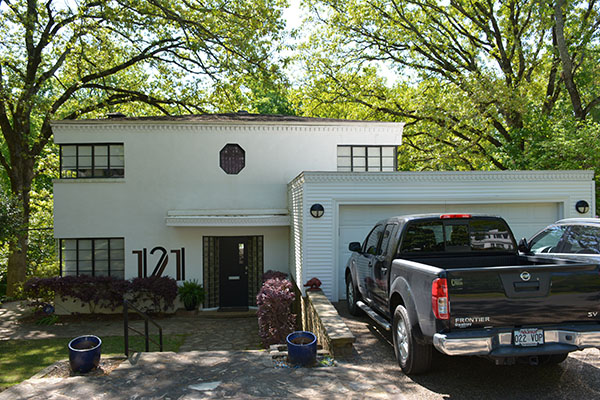

Listed in Arkansas Register of Historic Places on 12/05/18
SUMMARY
Located at 121 Normandy Road and built c.1943, the Leveck House represents an excellent example of the Art Moderne style.With its asymmetrical façade, curved glass-block windows around the front entrance, metal-framed windows, and use of windows that wrap around corners, the house illustrates some of the key characteristics of the style.As an excellent example of the Art Moderne style, the Leveck House is being nominated to the Arkansas Register of Historic Places under Criterion C with local significance.The installation of vinyl siding over parts of the original stucco-covered concrete-block walls precludes the house from being listed on the National Register, but it still possesses enough significance in order to be listed in the Arkansas Register.
HISTORY OF THE PROPERTY
Settlement in the Little Rock area began shortly after the turn of the nineteenth century.Although surveying land and offering it for sale did not begin until 1815, a few settlers were in the area prior to then.Edmund Hogan, for example, who was originally from Georgia and came to Arkansas via Missouri, was living on the north bank of the Arkansas River opposite Little Rock where he operated a ferry by 1812.Another distinguished early settler was Wright Daniel who settled at the base of Big Rock Mountain prior to 1814 and opened a gristmill in 1815.When the Arkansas Territory was created in 1819, the state’s first capital was at Arkansas Post.However, it was not the best location since it often flooded and was far away from the majority of the territory’s population.In 1820, a new centrally-located site for the capital was chosen on the south bank of the Arkansas River at Little Rock.[1]
Initial settlement and development in Little Rock was focused on the river.The original plat of Little Rock consisted of 88 square blocks stretching south from the river to what is now Eleventh Street.By the 1860s, however, the city began to expand beyond the original plat, notably with the platting of the Woodruff’s and Masonic additions on the city’s east side, the Wright’s Addition on the south side, and the Capitol Hill Addition on the west side.Apparently, building sites on the city’s west side were popular.An announcement in the November 21, 1872, issue of the Arkansas Gazette stated that “This property consists of twenty-seven full and fractional blocks, overlooking the Cairo and Fulton railroad as it leaves the city.…This is a fine property, and from its geographical position, will soon become a portion of the city.Upward of one hundred lots in the addition have already been disposed of, and are at this time being improved.”[2]
By the first part of the twentieth century as new development opened up west of the historic core of Little Rock, the new neighborhoods were platted using the latest principles in urban design.Throughout the nineteenth century, the grid was the pattern of choice for development.Although efficient, by the turn of the twentieth century it was beginning to be considered monotonous and dreary.As a result, neighborhoods and developments with curvilinear streets that followed the natural terrain became fashionable in the early 1900s.Moreover, having neighborhoods with curvilinear streets and larger lots, which created a more rural quality, was also a reaction to the conditions in big city slums.[3]
Although curvilinear streets created a more attractive neighborhood, by the 1920s they were also useful in slowing down automobiles.The popularity of the automobile increased dramatically by the 1920s making them more prevalent in residential areas.The use of curvilinear streets forced drivers to slow down and be more cautious in residential neighborhoods.[4]
The first neighborhood in Little Rock to use the idea of curvilinear streets in its design was Midland Hills, located on either side of Kavanaugh Boulevard where it branches off of Markham Street.The eastern portion of the neighborhood was platted in 1908 and the western portion was platted in 1911, and the whole area was developed by the Union Trust Company.Advertisements for the area made it clear that the neighborhood was special because of its design, stating:
Midland Hills is not laid out in the regulation way with the usual square blocks, but has been carefully platted with regard to the topography of the land.Its winding driveways follow the foothills and the hillcrests, giving this property a distinctive and most attractive appearance.
To plat in this irregular, attractive way demanded the sacrifice of many a lot to sell, but it has given Midland Hills the distinctive beauty for which such districts as University City in St. Louis, and Brookline, Mass., the richest city in the world, are famous.[5]
Although Midland Hills was a successful development, it was not until the 1920s that this type of development became common in Little Rock.The Pulaski Heights area of the city was home to the majority of these types of “residential park” developments in the 1920s, including Fairfax Terrace, Prospect Terrace, Cliffewood, Edgehill, and Shadowlawn.[6]
The development of Pulaski Heights began in the 1890s with the vision of Henry Franklin Auten and Edgar Eugene Moss, two attorneys from St. John’s, Michigan.In March 1891, Auten and Moss acquired 800 wooded acres just west of Little Rock with the hopes of developing it.However, Pulaski Heights grew very slowly during the 1890s – only eight families settled there – because of a lack of good transportation from downtown Little Rock.Although it meant that Pulaski Heights was a close-knit community, it did not do much for the area’s profitability for the Pulaski Heights Land Company.[7]
The key to successful development in Pulaski Heights was going to be the establishment of a streetcar line to the area, and when the Little Rock Traction and Electric Railway Company was given a franchise on September 27, 1901, they were required to build a line to the Heights if they were first given “a graded roadway, a free right-of-way and certain ‘other aid.’”Although various problems were encountered in completing the line, most notably completing a viaduct over the railroad line, the streetcar finally traveled to Pulaski Heights on Thanksgiving Day 1903 even though the line was not completely finished until the spring of 1904.[8]
Once the streetcar line reached the Heights, development occurred much more quickly with the Auten and Moss Addition being platted in 1903 and the Pulaski Heights (partial), Hollenberg, East Pulaski Heights, and Mountain Park additions being platted in 1904.By early 1905, the Height’s population was between 300 and 400 people, and on June 27, 1905, a petition was presented to incorporate the community.With one small adjustment to the proposed town’s boundaries, the petition was granted and Pulaski Heights was incorporated on August 1, 1905.[9]
The reason for seeking incorporation for Pulaski Heights was to aid in providing public improvements, specifically paving streets and providing sidewalks.Although incorporation had been a popular idea in Pulaski Heights, by 1915 there was talk of consolidating Pulaski Heights with Little Rock.During the initial discussions on consolidation, Little Rock promised that they would build a fire station in the Heights, something that the community had wanted to do but had not accomplished.Little Rock also promised twenty-five fire hydrants and twenty-five streetlights.The Heights would also be given access to the services of all of Little Rock’s city departments.The campaign to consolidate was a success and on January 13, 1916, Pulaski Heights became the Ninth Ward of Little Rock.[10]
Little Rock carried out its promises to the Heights – a fire station opened November 1, 1916, and the fire hydrants were being installed and the street lights were on hand awaiting installation.In the first few years after consolidation, only two small additions were platted in the Heights, Doyle Place in 1918 and the McGehee Addition in 1921.However, the boom of the 1920s brought intense development to the area and the establishment of eight new additions, including Fairfax Terrace, Prospect Terrace, and Cliffewood in 1924, Edge Hill and Oakwood Place in 1926, Shadowlawn in 1928, Pine View in 1929, and Normandy in 1930.[11]
Development in the area continued throughout the 1930s and up into the 1940s, 1950s, and 1960s, and it included the Normandy Addition, the location of the Leveck House, which was platted in 1930.The Normandy Addition was platted by Frank A. Pritchett, Engineer, and was filed for record with the county on April 7, 1930.The plat was officially recorded on April 9, 1930.The Normandy Addition consisted of 127 lots along Q Street (now Cantrell Road), Garfield Street (now Normandy Road and Normandy Lane), Cleveland Street, Arthur Street (now McMillen Trail), and Normandy Road.In addition to the 127 lots, it also included a public park on Garfield Street and three park and playground areas behind lots on Normandy Road.[12]It was on Lot 110 and part of Lot 111 that J. Donald and Ruth Leveck built their house, choosing the relatively uncommon Art Moderne style for the house.
The house that the Levecks had built was very modern when compared to many of the other houses that existed in the Normandy neighborhood.With its windows that wrapped around corners, use of glass block, and use of an octagonal window above the front entrance, the Leveck House was a great example of the Art Moderne style.The Art Moderne style, which is a simplified version of the Art Deco style, emerged from the L’Exposition Internationale des Arts Decoratifs et Industriels Modernes, which was a large exposition staged in Paris in 1925 to celebrate modernity in design.The style, which emphasized modernity, also developed as a reaction to the Art Nouveau style, which highlighted “decoration and aesthetic beauty” over “any sense of function.” [13]
Although the inspirations for the Art Deco style were varied, from African tribal art, ancient Egyptian culture, and Assyrian art, to Central American art and architecture and the eastern exoticism of Sergei Diaghilev’s Ballets Russes, the inspirations for Art Moderne were different.[14]After 1930, “the beginning of streamlined industrial design for ships, airplanes, and automobiles” became an influence on architectural styles, specifically Art Moderne.“The smooth surfaces, curved corners, and horizontal emphasis of the Art Moderne style all give the feeling that airstreams could move smoothly over them; thus they were streamlined.”[15]
John Blumenson, in his book Identifying American Architecture, describes the Art Moderne style as follows:
Soft or rounded corners, flat roofs, smooth wall finish without surface ornamentation, and horizontal bands of windows create a distinctive streamlined or wind-tunnel look which characterizes the Art Moderne style.The streamlined effect is emphasized by the use of curved window glass what wraps around corners.Ornamentation consists of mirrored panels, cement panels, and an occasional metal panel with low relief decoration around doorways and windows.Aluminum and stainless steel often are used for door and window trim, railings and balusters.Metal or wooden doors may have circular windows, large panels of glass or patterns with circular and angular outlines.[16]
The Levecks’ choice of the Art Moderne style for their house was an unusual choice.As The Abrams Guide to American House Styles states, “Art Deco, or Moderne (as its stripped down and streamlined later version is called), was associated mostly with large public buildings – skyscrapers, bus stations, movie theatres, and power dams.New York’s Chrysler Building and Radio City Music Hall are key monuments of the style.”[17]The style was never extremely popular with small-scale buildings, such as small office buildings or residences like the Leveck House.
The Leveck House illustrates the Art Moderne style in a couple of ways.The use of the octagonal porthole window above the main entrance along with the glass block and the windows that wrap around corners, illustrate the streamlined effect that was a popular hallmark of the style.These streamlined motifs illustrate the influence of modern industrial design, such as naval architecture, on the style.The use of stuccoed concrete-block walls for the house also emphasized the sleek modern finishes that were preferred in the Art Moderne style.It is not known where the Levecks got the idea for the house’s design, but it’s possible that it was inspired by the Knoop House (NR listed August 3, 1990) at 6 Ozark Point, which they may have been familiar with from their time living on Lee Avenue.
The Levecks purchased at least Lot 110 (and likely at least part of Lot 111) in the Normandy Addition for the location of their new home.The Levecks moved into their completed home at 121 Normandy either in 1943 or early 1944.The 1942 Little Rock City Directory listed their residence at 4318 Lee Avenue, but by 1944 it was listed as 121 Normandy.Donald’s background in the construction industry – he was the “son” in the J.H. Leveck & Son construction company – meant that he was well equipped to construct the house, and the design of the house was supposedly Leveck’s own design.The Leveck construction company built buildings all across Arkansas including buildings at the Arkansas Tuberculosis Sanatorium in Booneville (NR listed October 5, 2006), the former St. Anthony Hospital in Morrilton (NR listed March 28, 1986), Gibson Hall and the old Fieldhouse at the University of Arkansas in Fayetteville, Caraway Hall (NR listed September 10, 1992) and Brown Hall at Arkansas Tech in Russellville, and Nelson Hall and Cross Hall at Southern Arkansas University in Magnolia (NR listed January 20, 2010).[18]
Donald Leveck was a native of Little Rock and took over the firm J. H. Leveck and Sons, which had been founded in 1904, after his father’s death.His obituary indicated that he “built numerous public and commercial buildings in Little Rock and throughout the state, approaches to the Main Street and Broadway bridges, the state Tuberculosis Sanatorium at Booneville, the original Field House and a men’s dormitory at the University of Arkansas at Fayetteville, Central College at Conway, 10 dormitories and two mess halls at the Little Rock Air Force Base, the original Mount St. Mary’s Academy, the old St. Vincent Infirmary and Hot Springs’ DeSoto Hotel.”Interestingly, his obituary also notes that Leveck “pioneered solar heating” and “He incorporated into his own home which he built in 1942 in Little Rock solar heating for which he was acclaimed in scientific circles.”[19]
Leveck married Ruth Arnold, who was the daughter of Joseph D. and Catherine Dotterer Arnold.Ruth Leveck attended Arkansas AM&N where she received a degree in Library Science before continuing her studies at Peabody College in Nashville, Tennessee.From 1942 until 1958, Ruth handled public relations for J. H. Leveck & Sons, Contractors, before becoming librarian at Joe T. Robinson High School and then the Chief Librarian for Baptist Medical Center.She was also a prolific writer; her obituary noted that “She was the author of non-fiction articles published in 40 periodicals in England and the United States and in 1952, received first prize in a national non-fiction book contest held by Farrar & Rinehart of New York.She had been a feature writer for both Little Rock newspapers.”Ruth was also involved in various capacities with other writing organizations in Arkansas.Ruth Leveck died on December 31, 1976.[20]After Ruth passed away, Leveck remarried, marrying Mary Linus Adamson of Hot Springs, and he moved to Hot Springs, where he passed away on September 8, 1980. [21]
After the Levecks passed away, the Leveck House passed through a series of owners until the current owner, Chris Vanlandingham, purchased the house in August 2015.The Leveck House remains today a good and rare residential example of the Art Moderne Style in Little Rock.
SIGNIFICANCE OF THE PROPERTY
Interestingly, at the time that the Levecks had their house built in Little Rock, the Art Moderne style (and the related Art Deco style) were actually at the end of their in popularity in the United States.Great landmarks of the Art Deco style, such as the Chrysler Building (1928-1930) and the Empire State Building (1930-1932), both in New York City, had recently been completed.In addition, Rockefeller Center (1932-1940) and the famous South Beach area of Miami were both under development.Also, the Art Moderne bus stations built by Greyhound, including one in Blytheville, Arkansas, (NR listed August 17, 1987), were being built at the same time.No doubt, the Levecks would have been familiar with most, if not all, of these buildings, and the clean streamlined details of the style would have been attractive.
The use of the Art Moderne style, even though it is a clean, and in certain respects a no-nonsense style, allowed the Levecks to have a bit of fun and whimsy with the building’s architecture.The main entrance, especially, with the curved glass-block sidelights and octagonal window above, was an attention grabbing element.The windows wrapping around corners of the building also provided a bit of decoration, albeit in a modern way with a modern material.However, according to Virginia and Lee McAlester, “one or more corners of the building may be curved; windows frequently are continuous around corners; glass blocks are often used in windows, or as entire sections of wall; [and] small round windows are common” characteristics of the style.[22]
The Leveck House remains today a textbook example of the Art Moderne style, a style that was unusual in Arkansas in the 1940s.Fortunately, through the stewardship of sensitive owners since the house’s construction, the building has retained the character-defining features of the style. Although the house has been partially sided in vinyl siding over the stuccoed concrete-block walls, which makes ineligible for the National Register, the house is still a significant example of the style.As a result, as an excellent example of the Art Moderne style in Little Rock, the Leveck House is being nominated to the Arkansas Register under Criterion C with local significance.
BIBLIOGRAPHY
Blumenson, John J. G.Identifying American Architecture:A Pictorial Guide to Styles and Terms, 1600-1945.New York:W. W. Norton & Company, 1977.
“Donald Leveck, aged 85, retired building contractor.”Arkansas Democrat.9 September 1980, p. 10C.
Information on the Levecks from www.ancestry.com and in the files of the Arkansas Historic Preservation Program.
McAlester, Virginia & Lee.A Field Guide to American Houses.New York:Alfred A. Knopf, Inc., 1984.
Morgan, William.The Abrams Guide to American House Styles.New York:Harry N. Abrams, Inc., 2004.
“Mrs. Ruth Leveck dies at age 72.”Arkansas Democrat.2 January 1977, p. 3D.
Nichols, Cheryl Griffith.“Pulaski Heights:Early Suburban Development in Little Rock, Arkansas.”Master’s Thesis.The George Washington University, 1981.
Obituary for Donald Leveck.9 September 1980.Hot Springs Sentinel Record.Page unknown.
Plat for the Normandy Addition to the City of Little Rock.Found at:http://www.pagis.org/WebDocuments/ScannedPlats/894.PDF.
Roy, F. Hampton, Sr., and Charles Witsell, Jr., with Cheryl Griffith Nichols.How We Lived:Little Rock as an American City.Little Rock:August House, 1984.
Zaczek, Iain.Art Deco.Bath, England:Parragon, 2001.
[2] Ibid, pp. 19, 104.
[3] Ibid, pp. 192-193.
[4] Ibid.
[5] Ibid.
[6] Ibid.
[7] Nichols, Cheryl Griffith.“
[8] Ibid, pp. 19-20.
[9] Ibid, pp. 23 and 28.
[10] Ibid, pp. 28 and 32-33.
[11] Ibid, p. 34.
[12] Plat for the Normandy Addition to the City of Little Rock.Found at:http://www.pagis.org/WebDocuments/ScannedPlats/894.PDF.
[13] Zaczek, Iain.Art Deco.
[14] Zaczek, Iain.Art Deco.
[16] Blumenson, John J. G.Identifying American Architecture:A Pictorial Guide to Styles and Terms, 1600-1945.New York:W. W. Norton & Company, 1977, p. 79.
[17] Morgan, William.The Abrams Guide to American House Styles.New York:Harry N. Abrams, Inc., 2004, p. 342.
[18] Information on the Levecks from www.ancestry.com and in the files of the Arkansas Historic Preservation Program.
[19] Obituary for Donald Leveck.9 September 1980.Hot Springs Sentinel Record.Page unknown.
[20] “Mrs. Ruth Leveck dies at age 72.”Arkansas Democrat.2 January 1977, p. 3D.
[21] “Donald Leveck, aged 85, retired building contractor.”Arkansas Democrat.9 September 1980, p. 10C.
[22] McAlester, Virginia, and Lee McAlester.A Field Guide to American Houses.New York:Alfred A. Knopf, 1994, p. 465.