
This is part of a series of articles written by the Department of Arkansas Heritage to celebrate the Semiquincentennial of the United States. While Arkansas was not yet a territory or a state in 1776, the region that would become the state of Arkansas in 1836 played an important part in the evolution of the United States over the past 250 years.
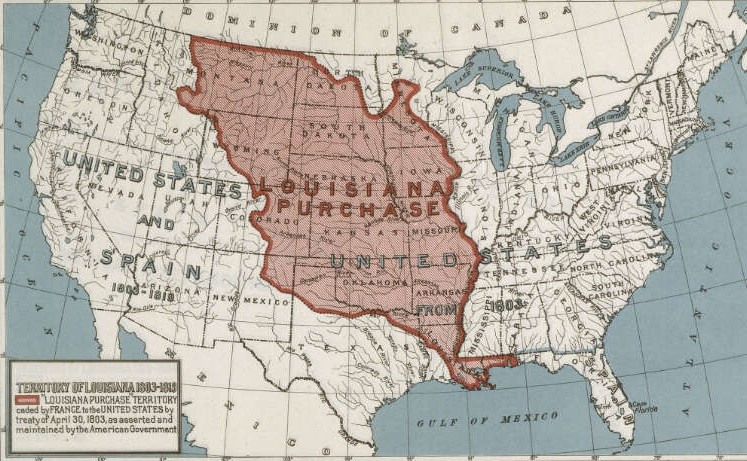
As First Consul of France, Napoleon Bonaparte needed money to continue his European battles. President Thomas Jefferson needed the Mississippi River and the port of New Orleans if the United States of America was to successfully expand westward. Jefferson sent his trusted friend and ally James Monroe to France to work with Robert Livingston, the U.S. Minister to France. Their objective was made clear by Jefferson: to purchase New Orleans, its port and the surrounding territory from France. They were authorized to pay up to $10 million (roughly $286 million in 2025). To their surprise, Bonaparte’s minister made a counteroffer – the entire Louisiana Territory for $15 million (approximately $429 million today). Monroe and Livingston agreed without hesitation, recognizing the impact the acquisition could have on the fledgling country.
The Treaty of Cession of the Louisiana Purchase was signed on April 30, 1803. The main terms of the pact included the agreed price of $15 million (consisting of $11.25 million in cash and $3.75 million in debt assumption); special privileges to Spanish and French ships to trade at the Port of New Orleans for 12 years; agreement by the United States U.S. to honor existing treaties between Spain and Native American tribes in the area; and that free inhabitants of the territory receive the "rights, advantages and immunities of citizens" as soon as possible.
The Louisiana Purchase changed the landscape of the United States, literally doubling the size of the young country by adding 828,000 square miles of land (though much of it was not actually owned by France and was inhabited by Native tribes). The country’s massive growth fueled westward expansion and the idea of Manifest Destiny.
Surveying the Louisiana Purchase
The first official survey of the newly acquired land began in May 1804, led by Meriwether Lewis and William Clark. In October 1804, President Jefferson directed William Dunbar and Dr. George Hunter to survey the southern portion of the purchase lands, providing the first English accounts of modern-day Arkansas and Louisiana, including thorough information on the hot springs found in the Ouachita Mountains. Yet a complete survey of the Louisiana Purchase did not begin until 1815, when President James Madison needed detailed information on the land to provide land bounties to veterans of the War of 1812.
.jpg?sfvrsn=21b82b62_0 "Photo from a reenactment of the survey of the Louisiana Purchase")
In November 1815, a group led by Prospect K. Robbins began at the mouth of the Arkansas River, surveying a north-south line. The group led by Joseph C. Brown began several miles upstream at the mouth of the St. Francis River and proceeded due west. Brown’s survey line is known as the baseline, and Robbins’s is called the Fifth Principal Meridian because it was the fifth north-south line surveyed in the U.S. The exact spot where the surveys converged became known as the “initial point” from which the lands in Arkansas, Missouri, Iowa, North Dakota, part of Minnesota and part of South Dakota would be measured. The initial point would also serve as the starting point for any future surveys of the lands. Robbins and his party selected two trees to demarcate the point.
Rediscovering the Witness Trees
In 1921, Tom Jacks and Eldridge P. Douglas were surveying sections of land near Lee and Phillips counties when they rediscovered the witness trees marked by Prospect K. Robbins and his team. Five years later, the local chapter of the Daughters of the American Revolution placed a granite monument within the swamp to mark the historic site.
Becoming an Arkansas State Park and Natural Area
The state legislature officially named the site as an Arkansas State Park in 1961 and local groups and state organizations continued to work together to make the park a reality. The Arkansas Natural Heritage Commission added the park to the Registry of Natural Areas in 1977. Soon after, the land was purchased and additional work on the park was completed in 1980. In June 1981, the historic park was also designated as a National Recreation Trail by the U.S. Department of the Interior.
A Historic Landmark
The historic marker that tells the story of the survey of the Louisiana Purchase was listed on the National Register of Historic Places in 1972 and became a National Historic Landmark in 1993. In 2021, the marker was raised and placed on a higher base, allowing the monument to be permanently above the swamp’s water level.
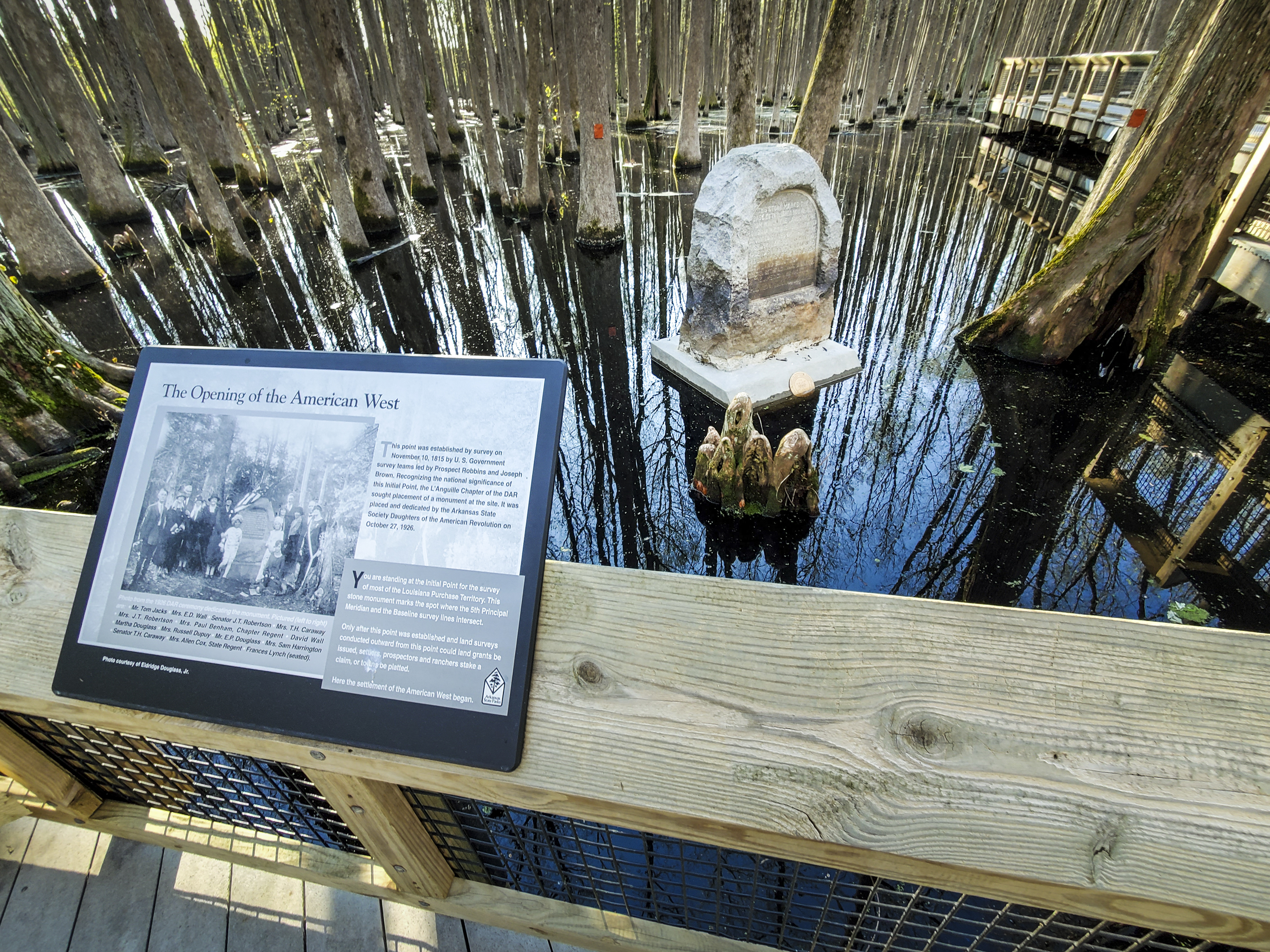
A wooden boardwalk winds from the swamp’s edge to the marker. Along the boardwalk, visitors can learn more about the historic land purchase, the surveys and the environment surrounding the park and natural area through a series of exhibit panels.
More to See and Do Near the Louisiana Purchase State Park and Natural Area
Within an easy drive of the Louisiana Purchase State Park and Natural Area, there are some great Arkansas Food Hall of Fame restaurants, Main Street communities, other Arkansas State Parks, museums and attractions to visit.
Plan a trip to Helena-West Helena, less than a 45-minute drive east. Along the way, stop by 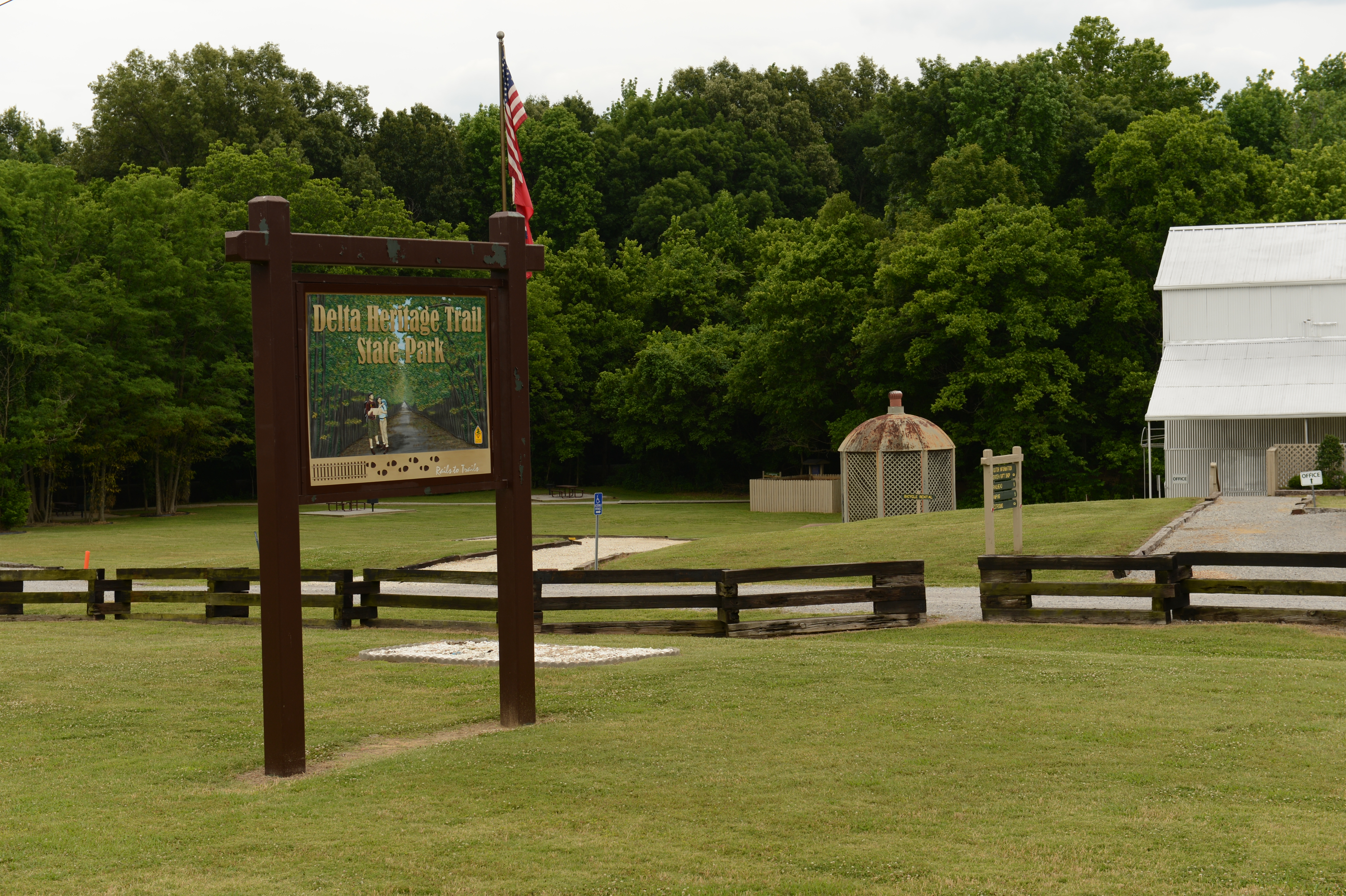 the Delta Heritage Trail State Park in Barton and enjoy a bike ride or a short hike along the crushed gravel trail. Head to downtown Historic Helena, a member of Main Street Arkansas’ Downtown Network Programs, for some shopping or a quick bite at one of the downtown restaurants. Make sure and include a visit to the Delta Cultural Center and the
 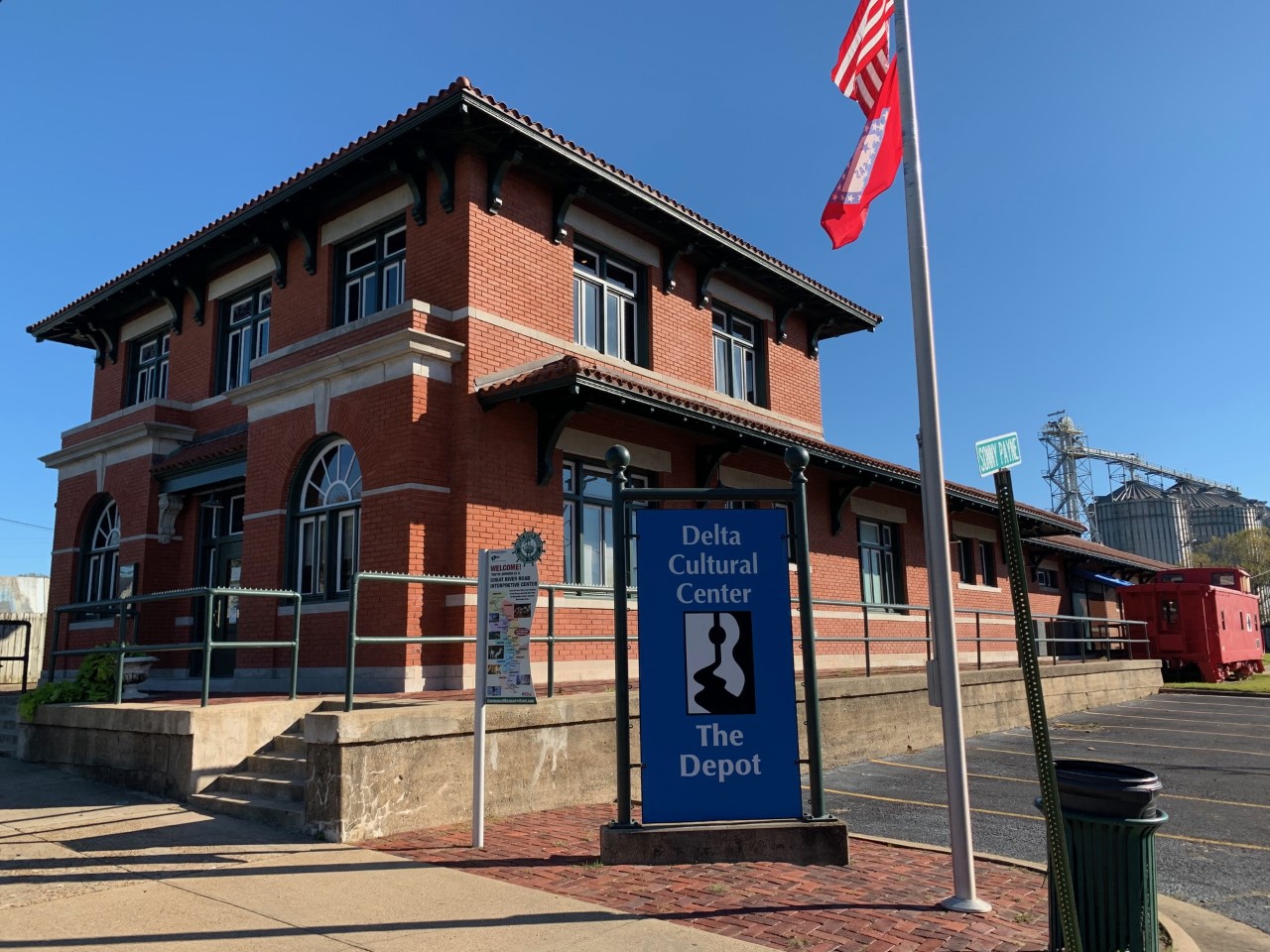 Helena Museum of Phillips County to learn more about the history and heritage of the Arkansas Delta. Schedule a tour of Delta Dirt Distillery, the only Black-owned craft distillery in the United States. Explore the nearby Mississippi River State Park and St. Francis National Forest and enjoy some fishing on the Mississippi River or at Storm Creek Lake. Schedule a guided bike tour of historic downtown area with the Helena Adventure Company. Explore the Civil War, Civil Rights and music heritage sites throughout the town. Historic Helena offers a variety of activities for history buffs, outdoor enthusiasts and everyone in between.